When Stretching is the Wrong Answer
Physical Therapy

You wake up and your lower back feels a bit tight. So you do what so many people are advised to do when muscles tense up: You stretch. The tightness is relieved for a few minutes, but soon the tension returns and your back stiffens up again. Was the stretch the problem or is something else going on?
Stretching promotes muscle flexibility and joint mobility. It’s rightly an integral part of any fitness routine. But it’s not a cure-all for all types of pain. There are times when stretching makes pain worse. The answer lies in learning what is making your muscles taut and finding a way to loosen them up.
Why Stretching Makes Pain Worse in Some Situations
Anytime a muscle feels tight or achy our first response is to stretch. It’s easy to see why. Stretching often brings immediate relief, and it’s easy to do at home. But in some cases stretching is only a temporary solution, and the stiffness and pain soon flairs.
Many also turn to stretching to improve their joint and muscle mobility. However, stretching too vigorously and for too long may have the opposite effect and cause muscles to tense up.
Or there may be a deeper issue at play. Your muscle tightness may be compensating for an unstable joint, muscle weakness elsewhere, or nerve compression.
When Stretching Makes Pain Worse
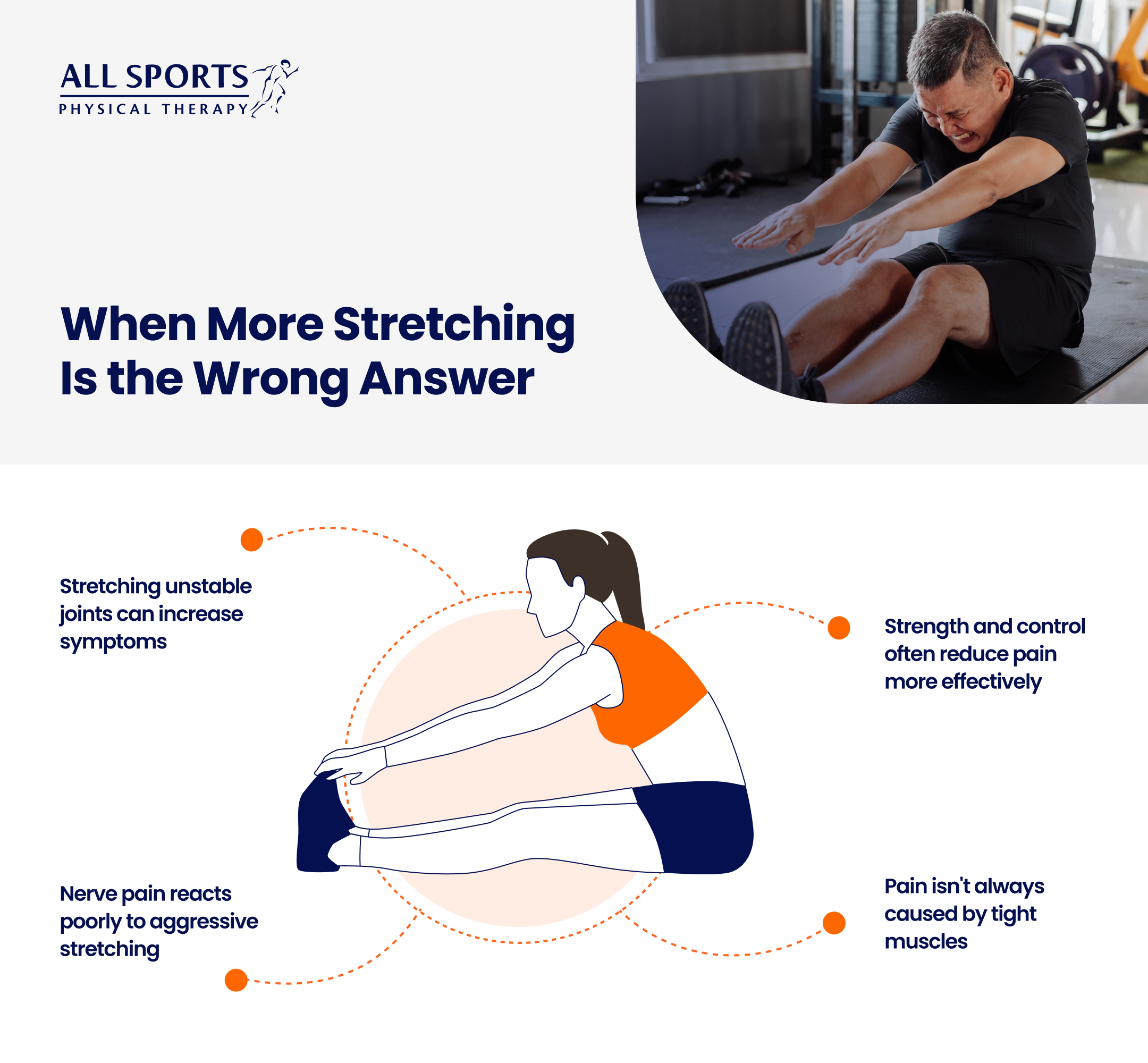
Stretching isn’t bad for you. But a tight and painful hamstring, hip, or lower back even repeated stretching exercises or foam rolling is a red flag that a different problem is at fault.
Nerve tension. Your nervous system runs through your muscles, joints, and other tissues to help your body move. An inflamed or injured nerve becomes tense and cannot move freely. Stretching the muscle around the nerve will only irritate it further.
Joint hypermobility. When you stretch your muscles, you’re also stretching the ligaments around the joint. Loose ligaments can no longer support the joint, and the muscles tighten up to stabilize and support the joint.
Overstretching. Stretching may feel uncomfortable, but it shouldn’t be painful. Yet pain and tightness may occur if you press your joints and muscles beyond their normal limits, especially if the muscles are already weak. Weak muscles may resist the stretching and tighten up as a protective measure. To avoid overstretching, hold a stretch for 30 to 60 seconds and never bounce when stretching.
Muscle imbalances. Muscles may pick up the slack when other muscles are not doing their job. For instance, a weak core may force the hamstrings to compensate, which leads to tension and pain in those muscles.
Signs Stretching Is the Wrong Tool
Stretching may briefly resolve symptoms, but it may not address the underlying cause. Paying close attention to how your body responds provides clues that stretching isn’t unlocking those stiff muscles.
- Lingering pain after repeated stretches lasting 1 to 2 weeks
- A sharp, stabbing pain when stretching
- Tingling or numbness in the extremities
- Knots in your back or shoulder that don’t go away
- Significant joint pain and stiffness
- A “crunching” sensation in the joint
- Restricted mobility
What the Body Often Needs Instead of Stretching
Stretching your muscles for mobility and pain reduction will always be a vital element in your exercise program. But it’s only one part of a well-rounded fitness plan. Don’t neglect other components to get your body in shape.
Strength training. Rather than stretching muscles, strengthen them. Build up and stabilize your core muscles, hamstrings, and glutes and those muscles won’t feel tight.
Improve joint mobility. Unlock a stiff joint and the muscles will relax, too. Lunges, for example, can improve hip mobility and as a result, loosen up tight flexor muscles.
Stretch right. Going beyond a joint’s or muscle’s range of motion may be doing more harm than good. Brief stretches that take you up to your range of motion and back again are better options. Slow squats and leg swings improve flexibility while also giving you control over the movement.
Eccentric exercise. Eccentric exercise lengthens the muscles while under tension. A pullup is a good example. As you pull up you shorten your muscles. Instead of dropping to the ground immediately, you slowly control your movement as you lower yourself down.
How Our Physical Therapists Help Identify the Right Approach to Stretching
If stretching is causing you pain, see the physical therapy team at All Sports Physical Therapy. Our physical therapists are trained to uncover what may be the source of your muscle stiffness.
Full body evaluation. Every joint and muscle in your body works together to get you moving. If one area is weak it can affect another part of your body. Low back tightness, for example, may be related to a weak core.
Movement assessment. We’ll review how you move and whether you need to improve your mechanics. Runners often experience calf tightness because their stride is off. We can help them adjust their gait to resolve the tightness. We can also suggest ways to improve your posture.
Individualized approach. Our team will craft a customized exercise program based on where your muscles are taut.
Manual therapy. Massage, soft tissue therapy, or dry needling can be free tight muscles.
Pain when stretching is a sign your muscles are overburdened or another issue is causing the tension. Contact our team today to unlock stiff muscles and reach your full potential.
FAQs
Can stretching make pain worse?
Yes, it can. Aggressive stretching may irritate compressed nerves or push your muscles beyond their limit, resulting in more tension. Tense muscles may be caused by an unstable joint that forces the muscles to tense up to support the joint. An evaluation by a physical therapist can discover the underlying cause.
Why does stretching make my back pain worse?
Because it’s not addressing the source of the pain. Lower back pain is often attributed to nerve tension. Stretching your back can further tug on the nerve.
Can stretching irritate nerves?
Nerves run through muscles. Anytime a nerve is injured or compressed, stretching the muscle puts more pressure on the affected nerve.
Should I stop stretching if it hurts?
Yes, right away. Stretching may cause some discomfort, but never intense or shooting pain. Mobility limitations and other symptoms (numbness, tingling in the extremities) are signs you should avoid stretching and see a physical therapist.
How does physical therapy help when stretching?
Physical therapists are trained in movement assessment and can tell if one muscle group is compensating for another. That imbalance often leads to muscle tightness. Physical therapists can develop an individualized plan to strengthen and stabilize your muscles and reduce the tension.