What “Your Glutes Aren’t Firing” Actually Means
Sports Medicine

If you sit all day you’re at risk of dead butt syndrome. But you can get your butt and glutes to wake up.
Your butt feels numb when you get up from your chair. Or your lower back and hips sometimes ache. You ask your sports trainer or physical therapist and are told, “Well, your glutes aren’t firing.”
What they’re saying is the gluteal muscles in your buttocks are failing to pull their weight. The three gluteal muscles in your butt — the gluteus maximus, gluteus medius, and gluteus minimus — stabilize your hips and pelvis. They “fire” up when you walk, jump, run, and lift your legs when going up stairs. When those muscles weaken, you may experience what is known as gluteal amnesia or dead butt syndrome. Despite the funny names, dead butt syndrome/gluteal amnesia can cause pain in other parts of the body and affect your athletic performance. Luckily, you can awaken your sleepy butt with exercises and posture retraining.
What Is Gluteal Amnesia and Its Causes
Dead butt syndrome is a bit misleading. The gluteal muscles aren’t “dead.” They’ve simply “forgotten” their purpose after not being engaged enough. The better term is gluteal amnesia and it’s due mostly to sitting all day at work.
Sitting all day. Your seated position shortens and tightens the hip flexor muscles at the front of your hips. As a result, the gluteal muscles lengthen and become a bit lazy as they are not activated while seated.
Posture. The lengthening of the gluteal muscles can also cause anterior pelvic tilt, or a forward rotation of the pelvis. This forces the spine into an unnatural curve, or swayback. Sitting hunched over at your desk is another probable reason.
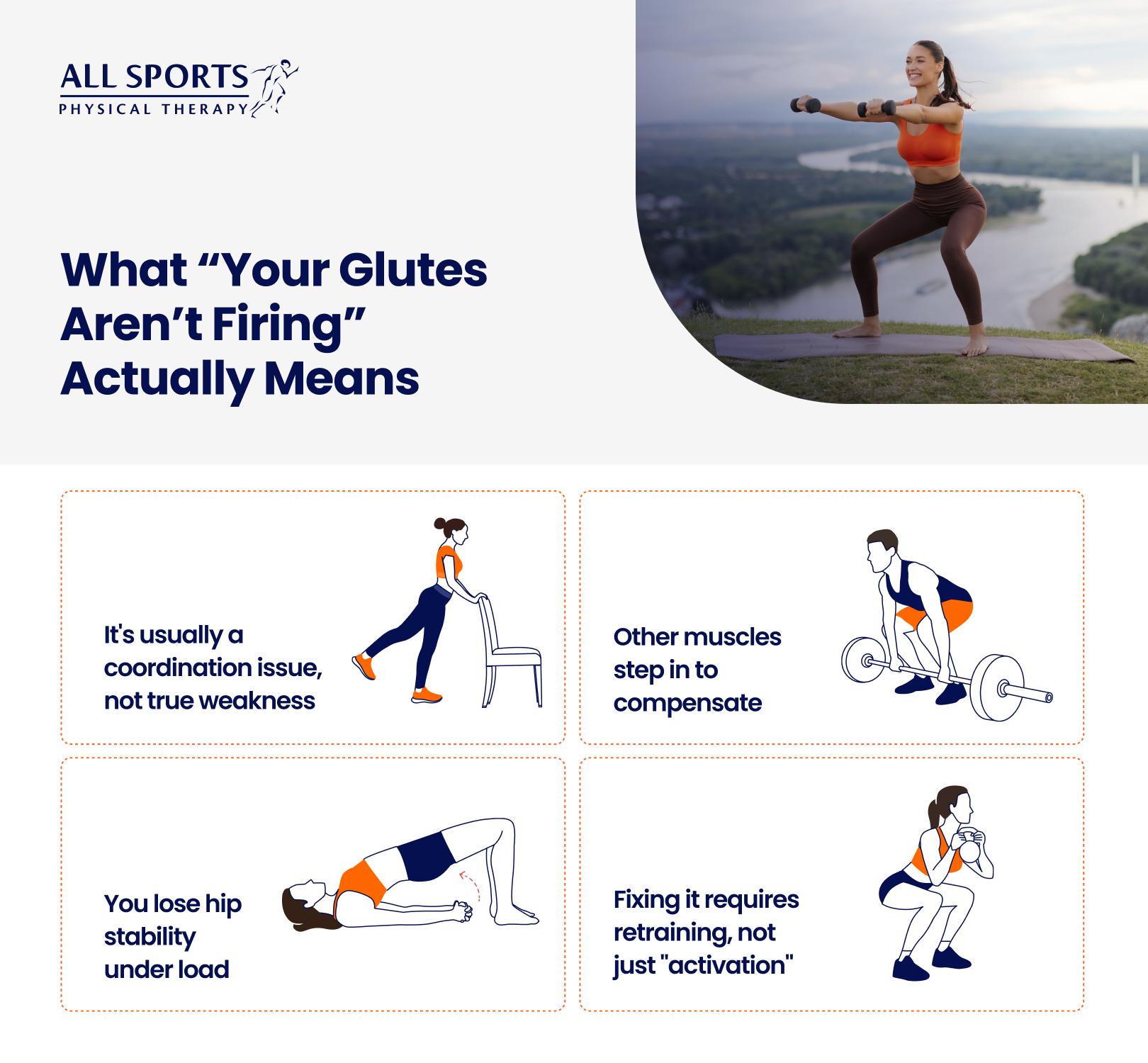
Muscle overload. Other muscles step in for non-performing glutes. For example, the hamstrings may take on more of their load when the gluteal muscles are weak, leading to hamstring strains. This imbalance can trickle down to the knee and cause pain in that joint.
Overuse of one muscle group. Focusing on one muscle group at the expense of others can lead to weak glutes. Cross-train so all muscle groups are worked equally.
Common Signs of Poor Glute Function
A numb sensation in the buttocks is a common symptom of gluteal amnesia. Rising from your seat may be a bit awkward, too. But there are other signs of the condition:
- Lower back pain
- Lateral hip pain and loss of mobility
- Knee stress and pain
- Fatigue during activity or inability to perform at your peak
How to Tell if You’re Glutes Aren’t Firing
Pain and numbness in the buttocks can be signs of gluteal amnesia. Several tests can also indicate your glutes aren’t firing on all cylinders.
The Trendelenburg test. Lift one leg while standing. If your pelvis sinks on the side of the raised leg, your gluteus medius may be weak on the opposite side.
The belt test. Your belt buckle should be parallel to the floor. But if it leans toward the front, you may have anterior pelvic tilt.
Squeeze your buttocks. Place your hands under your butt and squeeze the right check and then the left. You should feel the glutes engage.
Dead Butt Syndrome vs Gluteal Tendinopathy
Dead butt syndrome or gluteal amnesia primarily affects the gluteal muscles. However, gluteal tendinopathy is a chronic condition in which the tendons may be strained or damaged. Both have similar symptoms.
Dead butt syndrome
- A general weakness in the gluteal muscles
- Typically caused by prolonged sitting
- Characterized by numbness or pain in the buttocks
- Can be reversed with strengthening exercises and improving posture.
Gluteal tendinopathy
- A deterioration of the tendons connecting the buttock muscles
- A chronic condition characterized by severe hip pain
- Typically affects older women
- Treatment involves extensive physical therapy, rest, avoiding activities that cause pain (walking up stairs), and other therapies
How Physical Therapy Restores Glute Function
Fortunately, you have plenty of options to perk up your slumbering butt. A physical therapist can help you through a plan to re-activate your glutes.
Movement and posture analysis. A physical therapist can assess your gait and posture to pinpoint if those are leading to weak gluteal muscles. You may have an anterior pelvic tilt that needs to be corrected. Engage your core and glutes when standing and walking.
Your desk posture. Dead butt syndrome is mainly due to how you sit in your desk chair. So, improving your desk posture can be key to awakening your glutes.
- Sit up straight with your back and shoulders relaxed. No slouching.
- Make sure your lumbar spine is supported.
- Your monitor should be at eye-level.
- Keep your feet flat on the floor with knees at a 90-degree angle.
- Bend elbows at 90 degrees.
- Get up frequently or do desk-based exercises.
Exercises. Targeted exercises can build up and energize the glutes.
Side-lying leg lifts
- Lie down on your right side with your legs extended and stacked
- Slowly raise your left leg toward the ceiling before bringing it back down
- Do 15 to 30 reps for a full set
- Repeat with your right leg going up
- Do up to three sets per leg.
Clamshell
- Lie down on your right side with your hips stacked, knees bent and feet touching
- Lift your bent left leg toward the ceiling as you open your legs up like a clam
- Once you hit the top of the movement, return your left knee to the starting position
- Repeat the motion 20 to 40 times for a full set.
- Flip over and repeat with your right leg rising 20 to 40 times
- Perform up to three sets per leg
Get Your Glutes Up and Running Again
At All Sports Physical Therapy, we’re very familiar with gluteal amnesia, its causes, and how to treat it. We’ll take a look at your body dynamics — how you stand, walk, and sit — to find the source of your weak glutes. Then, we’ll prescribe exercises targeting your glutes.
If you find your hip, butt, or back pain worsens and your movements are increasingly uneasy, come see us for a treatment plan to energize your glutes. Schedule your appointment today.
FAQs
What does “dead butt syndrome” mean exactly?
Well, it doesn’t mean your butt is “dead.” It means the gluteal muscles in your buttocks are weak and not performing their function. The medical term is gluteal amnesia.
Why aren’t my glutes firing?
Because they’re weak, mainly due to sitting all day. Sitting causes the hip flexor muscles to shorten. In response, the gluteal muscles lengthen and lose strength. That leads other muscle groups, like the hamstrings, to pick up the slack.
What are the symptoms of dead butt syndrome?
A feeling of numbness or achiness in the butt. You may have difficulty getting up from a chair. Hip, knee, and lower pain are also common symptoms as muscles around those joints pitch in to compensate for the weak glutes.
How to fix gluteal amnesia?
Physical therapy includes glute strengthening exercises. A physical therapist may analyze your posture and movement to see if those are affecting the glutes. You might want to consider a standing desk. Cross-training that focuses on all muscle groups is also beneficial.